
The Cost of Waiting Another Season
Skip storm prep this fall and the bill doesn't show up as a line item — it shows up as a bent track after a windstorm, a door that won't seal against driving rain, or a panel that buckles inward and takes the opener, the springs, and sometimes the header above it with it. Once a garage door fails during high wind, you're not just replacing a door. You're dealing with water damage to whatever's stored inside, a compromised entry point into an attached home, and an emergency repair call instead of a planned one. A few hours of inspection now is cheaper than any version of that scenario.
Why the Garage Door Is Your Home's Weakest Wall
Every other wall in a typical house is a solid, braced structure. The garage door is a large moving panel held in place by springs, tracks, rollers, and a handful of hinges — and it's usually the single biggest opening in the entire exterior. When wind hits a house, pressure builds on the windward side and pulls on the leeward side. A standard wall shrugs this off. A garage door, especially an older or non-reinforced one, can flex, bow, or rip loose from its tracks under sustained gusts or a sudden pressure change. Once that door fails, wind gets into the garage, pressurizes the whole structure from the inside, and the risk to the roof and walls goes up dramatically. This is why building codes in many wind-prone regions now require impact- or wind-rated doors on new construction — the physics isn't theoretical.
Signs Your Door Won't Hold Up
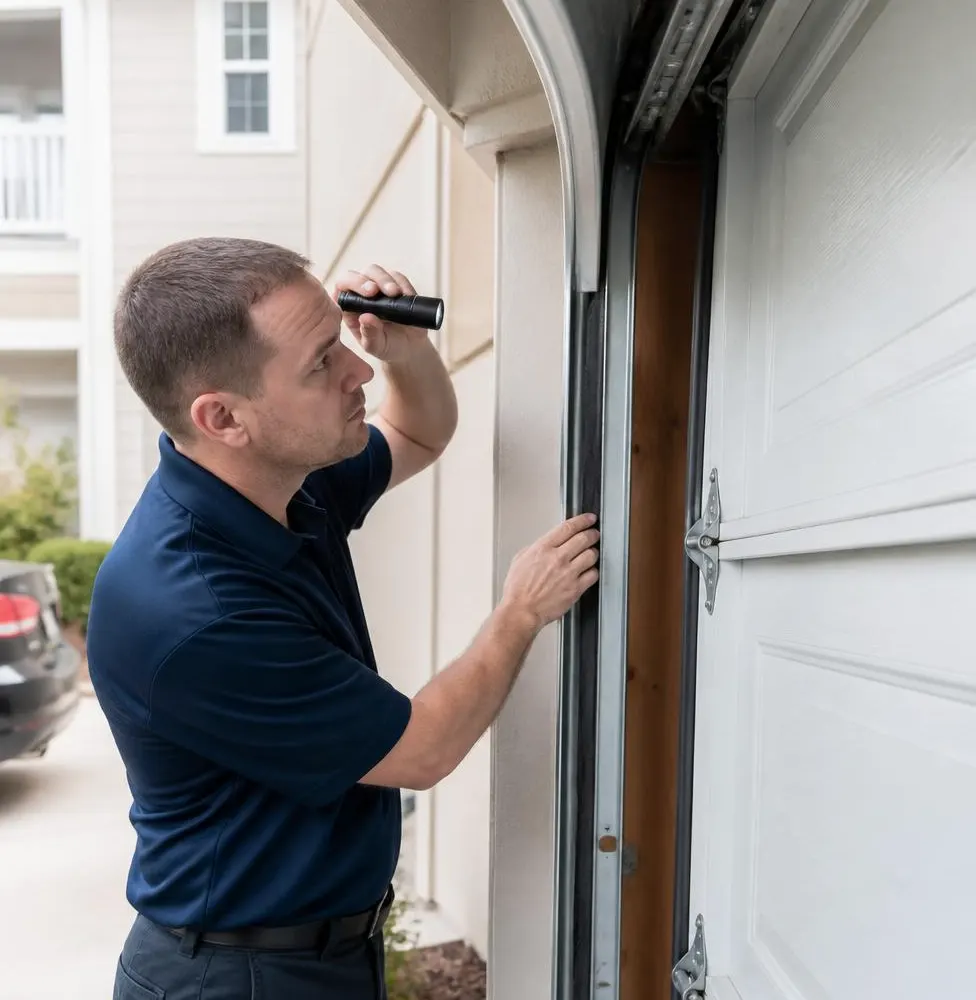
Before the next line of fall storms moves through, walk out to the garage and actually look at the hardware, not just the paint.
- Track separation: Gaps between the rollers and the track, or a track that's visibly bent, bowed, or loose from the wall.
- Soft or sagging panels: Press on the bottom and middle panels. Any give, especially on an older steel or wood door, means the reinforcement has weakened.
- Worn or missing weatherstripping: Cracked, brittle, or flattened seals along the bottom and sides let wind-driven rain push straight through.
- Loose hinges or fasteners: Vibration from wind and daily use works screws loose over years. A quarter-turn with a screwdriver on every hinge and bracket takes ten minutes.
- A struggling opener: If the opener strains, reverses unexpectedly, or runs louder than it used to, the door may already be out of balance — which gets worse under wind load, not better.
Storm-Proofing Steps to Take Now
- Tighten everything. Hardware, track brackets, hinge bolts — all of it loosens gradually and all of it matters more once wind is pushing on the door.
- Check the braces. Most sectional doors have horizontal struts on the back of the top panels. If yours are missing, bent, or were never installed, that's the single biggest upgrade you can make before storm season for a relatively small cost.
- Inspect the springs. Springs under tension are what keep a heavy door controlled during opening and closing, and a weak or mismatched spring puts more strain on the whole system exactly when you don't want it — during a storm-driven power blip or a fast manual close. A visibly stretched, rusted, or gapped spring coil is worth having checked before it's load-tested by 50 mph gusts.
- Replace worn weatherstripping. New bottom seals and side seals are inexpensive and keep both wind-driven rain and cold air out — a dual-purpose fix heading into Michigan's wet falls and brutal winters.
- Test the auto-reverse safety feature. Place a piece of wood on the ground where the door closes. It should reverse on contact. This matters year-round, but a door that doesn't sense obstructions properly is also one whose sensors and alignment are already compromised.
- Consider a battery backup for the opener. Severe storms here often bring power outages along with the wind. A battery backup means you're not stuck manually hoisting a heavy door in the dark and rain, and it keeps the door operable (and closed) if the power drops mid-storm.
Don't Forget What's Coming Right Behind the Storms
Fall storms are really just the opening act. Once the cold sets in, rubber seals stiffen and shrink, road salt and slush get tracked onto tracks and hardware, and the spring thaw later brings its own moisture problems. Any wind damage or loose hardware left unaddressed in October tends to get worse — not better — once ice and deep cold are added to the mix. Doing a real inspection now covers both problems at once.
When to Call Ionia Garage Door
If you've found a bent track, a soft panel, a spring that looks stretched or uneven, or an opener that's struggling, that's past the point of a DIY fix and into the range where a bad call can mean a door coming off its track entirely. Our Garage Door Maintenance service covers exactly the checklist above — hardware, balance, seals, and opener function — done properly with the right tools and torque specs, especially for spring tension, which is genuinely dangerous to adjust without the right equipment. And if a storm does catch you off guard and the door won't close, won't open, or is visibly damaged, our Emergency Garage Door Service gets someone out to secure the opening and make the repair so you're not stuck with a wide-open garage overnight.
If you're in Ionia, Portland, Belding, Saranac, Lake Odessa, Lowell, Lyons, or Muir and it's been a while since your garage door was actually inspected, give Ionia Garage Door a call before the next storm front moves through. A short visit now beats an emergency one later.